
The New Rules of Sports Visibility
We’ve all seen that frustrating highlight where a player loses a ball mid-air because it vanished into a blinding light. It’s practically a sports meme at this point—but for lighting designers and engineers, it’s a very real issue. Modern lighting standards exist specifically to prevent those moments. The Illuminating Engineering Society’s most recent recommended practice, ANSI/IES RP‑6‑24, includes updated guidance to improve visibility, reduce glare, and support both athletes and spectators.
And if you’re wondering when lighting guidelines got so detailed, most of the major updates actually happened recently. The last big overhaul was in 2025, when the IES released RP‑6‑24—a comprehensive revision that updated glare metrics, uniformity requirements, spill‑light management, vertical illuminance, and even added the IES “Five Principles for Responsible Outdoor Lighting.” This replaced the 2022 edition and refined earlier 2020 guidance that facilities had been using for years. In short, the standards evolved fast because sports lighting technology (especially LED systems) evolved fast. With that context in mind, several key principles guide good sports lighting design today.
Light Levels: More Than Just Bright Enough
“How much light do we need?” depends on a mix of factors—sport type, indoor vs. outdoor settings, level of play, and whether events are televised. Modern recommendations come from IES RP‑6‑24, which includes updated illuminance levels and places a stronger emphasis on vertical illuminance to help players and cameras read faces, numbers, and fast‑moving objects.
Sports organizations like USTA, NFHS, and NCAA may require even more for high competition or broadcast play.
Fixture Location: Where You Put the Lights Matters
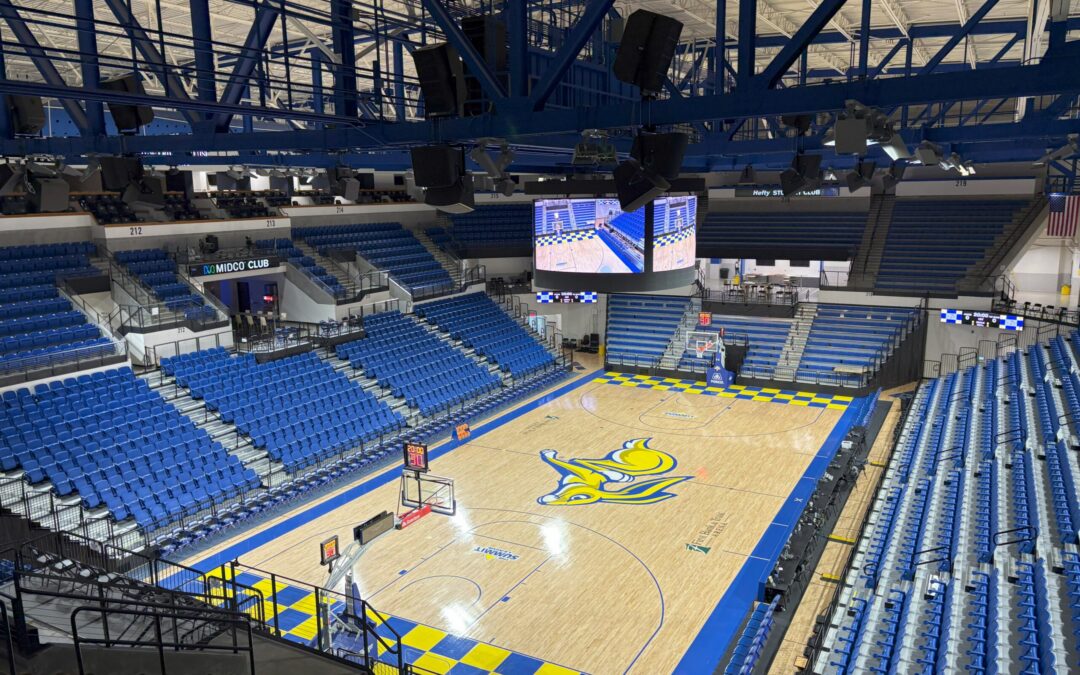
Placement influences glare, uniformity, and whether a ball flies directly into a light beam. Indoors, designers coordinate carefully around beams, scoreboards, and ductwork. Outdoors, the key variables are pole height, setback, and aiming direction. Newer guidelines emphasize higher mounting heights to reduce glare, preserving vertical visibility for cameras and players, and keeping fixtures clear of spectator sightlines.
Aiming Angles: Aiming Wrong = Instant Glare
Aiming fixtures too low causes blinding hotspots; too high and the field becomes uneven. Designers still follow the familiar 25° minimum aiming angle, but RP‑6‑24 adds stronger guidance for precise computer-based aiming, glare shields and optical cutoff, and compliance with updated glare metrics from IES and CIE. This helps prevent the dreaded “lost it in the lights” moment.
Uniformity: Smooth, Predictable Lighting
Uniformity is the secret sauce of playability. RP‑6‑24 uses updated ratios and requires better vertical uniformity for televised sports. Uneven lighting forces players’ eyes to constantly adjust between bright and dark zones. Smooth uniformity helps everything feel consistent and fair.
Cutoff, Obtrusive Light & Glare: Good for Players and the Community
Modern sports lighting must perform well and respect surrounding areas. RP‑6‑24 incorporates the IES Five Principles for Responsible Outdoor Lighting, focusing on reducing glare, limiting light trespass, protecting the night sky, and using only the light needed. Today’s LED fixtures allow much more precise optical control, helping keep the light on the field and out of the neighbors’ windows.
Maintained Levels: Designing Beyond Day One
New fixtures look great at installation, but every system experiences depreciation. Modern standards require designers to plan for LED lumen maintenance, dirt and environmental depreciation, and control strategies that preserve long-term performance. This ensures the field still meets lighting targets years down the road.
Why This All Matters
Today’s sports lighting isn’t just “brighter.” It’s smarter, more controlled, and more athlete‑focused than ever. With big updates in 2025—and significant changes only a few years before that—current standards reflect the latest LED technology, broadcast needs, and community expectations.